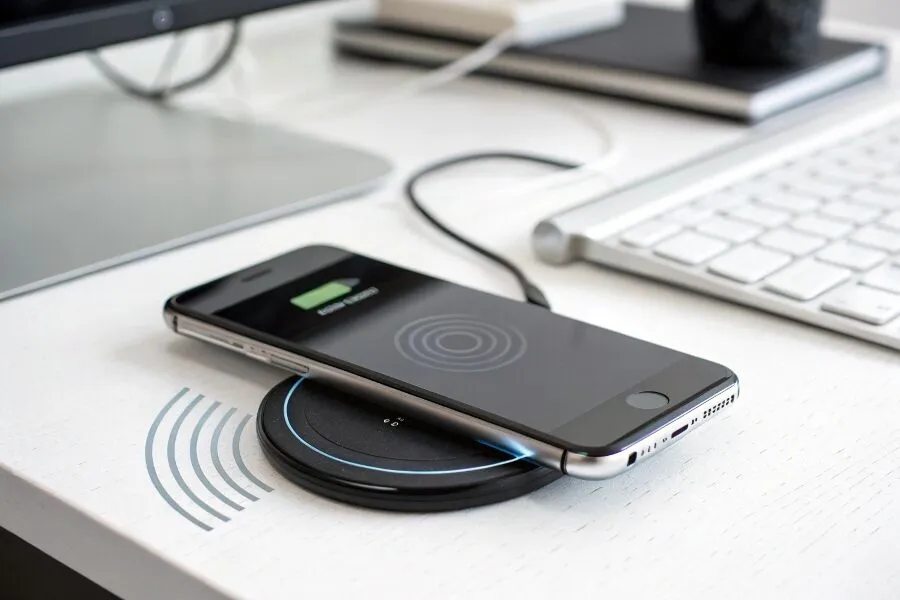
Wireless charging often feels like science fiction. You simply place your smartphone, earbuds or smartwatch onto a charging pad, and the battery begins charging without plugging in a cable.
There are no exposed electrical contacts, no visible connectors and no moving parts. Yet power somehow travels from the charging pad into the battery.
Many people imagine electricity jumping through the air, but that isn't what happens.
Wireless charging works because of one of the most important discoveries in physics: electromagnetic induction. Rather than sending electricity directly through the air, the charger creates a changing magnetic field that transfers energy from one coil to another.
In many ways, a wireless charger behaves like a transformer whose two coils have been physically separated.
THE BASIC IDEA
A normal wired charger follows this path:
Wall Outlet
↓
Power Adapter
↓
USB Cable
↓
Phone
↓
Battery
A wireless charger removes the cable entirely.
Wall Outlet
↓
Wireless Charger
↓
Magnetic Field
↓
Receiver Coil
↓
Battery
The only thing traveling between the charger and the phone is a rapidly changing magnetic field.
THE MAIN COMPONENTS
Every wireless charging system contains two separate devices.
TRANSMITTER (Charging Pad)
- AC Power Supply
- Rectifier
- Filter Capacitors
- High-Frequency Inverter
- Power MOSFETs
- Transmitter Coil
- Ferrite Shield
- Controller IC
- Foreign Object Detection System
RECEIVER (Inside the Phone)
- Receiver Coil
- Ferrite Shield
- Rectifier
- Filter Capacitors
- Battery Charging IC
- Battery Management System (BMS)
- Temperature Sensors
STEP 1: POWER ENTERS THE CHARGER
Electricity from the wall outlet first enters the power adapter.
The adapter converts:
- 120V AC
- or
- 230V AC
into a safe low-voltage DC output, usually:
- 5V
- 9V
- 12V
- 15V
- Sometimes higher for fast charging.
This DC power enters the wireless charging pad.
STEP 2: THE CHARGER CREATES HIGH-FREQUENCY AC
Inside the charging pad, power MOSFETs rapidly switch the DC voltage on and off.
The controller produces alternating current at frequencies typically between:
- 100 kHz
- 205 kHz
- Sometimes higher depending on the charging standard.
This high-frequency AC flows into the transmitter coil.
STEP 3: THE TRANSMITTER COIL GENERATES A MAGNETIC FIELD
The transmitter coil is usually a flat spiral made from many turns of insulated copper wire.
As alternating current flows through the coil, the magnetic field constantly expands, collapses and reverses direction.
According to Ampère's Law:
Electric Current
↓
Magnetic Field
Because the current changes thousands of times every second, the magnetic field also changes thousands of times every second.
This changing magnetic field extends a short distance above the charging pad.
STEP 4: THE RECEIVER COIL CAPTURES THE MAGNETIC FIELD
Inside every compatible smartphone is another copper coil.
When this receiver coil enters the changing magnetic field, Faraday's Law of Electromagnetic Induction comes into action.
A changing magnetic field passing through a conductor generates an electrical voltage.
The phone's receiver coil therefore produces alternating current without ever touching the charging pad.
At this point, electricity has effectively crossed the air gap.
STEP 5: THE PHONE CONVERTS AC BACK INTO DC
Batteries cannot be charged with alternating current.
The receiver electronics immediately pass the induced AC through:
- Bridge Rectifier
- Smoothing Capacitors
- Power Management IC
The output becomes clean DC voltage suitable for charging the battery.
STEP 6: THE BATTERY MANAGEMENT SYSTEM TAKES OVER
The Battery Management System continuously monitors:
- Battery voltage
- Charging current
- Battery temperature
- State of charge
- Cell health
It adjusts charging current hundreds of times every second to maximize battery life while preventing overheating.
WHY THE COILS MUST BE ALIGNED
Magnetic fields weaken rapidly with distance.
Maximum efficiency occurs when:
- Both coils are centered.
- They are close together.
- Their magnetic fields overlap as much as possible.
If the phone is moved too far away from the center, less magnetic flux reaches the receiver coil.
The result is:
- Slower charging
- Lower efficiency
- More heat
This explains why many charging pads have alignment marks or magnetic positioning systems.
HOW MAGSAFE IMPROVES WIRELESS CHARGING
Apple's MagSafe system adds a ring of carefully positioned magnets around both the transmitter and receiver coils.
These magnets automatically pull the phone into the ideal charging position.
Benefits include:
- Better coil alignment.
- Higher charging efficiency.
- Less wasted energy.
- Reduced heat generation.
- More consistent charging speeds.
Other manufacturers have adopted similar magnetic alignment systems for their own devices.
WHY METAL OBJECTS CAN BECOME HOT
The magnetic field does not distinguish between a receiver coil and other conductive objects.
If a coin, key, ring or other metal object is placed on the charging pad, eddy currents may also be induced inside it.
These currents generate heat.
This is why modern chargers include:
Foreign Object Detection (FOD)
The charger constantly checks whether the energy it is transmitting is being received correctly.
If it detects abnormal power loss caused by an unexpected metal object, it immediately reduces power or shuts down.
WHY WIRELESS CHARGING IS LESS EFFICIENT
In wired charging:
Electricity
→ Cable
→ Phone
Very little energy is lost.
In wireless charging:
Electricity
→ Magnetic Field
→ Air Gap
→ Receiver Coil
→ Rectifier
→ Battery
Each conversion introduces losses.
Typical efficiencies:
- Wired charging: 90% to 98%
- Wireless charging: 70% to 90%
The missing energy is mostly converted into heat.
WHY THE PHONE AND PAD GET WARM
Heat comes from several sources:
- Resistance in the transmitter coil.
- Resistance in the receiver coil.
- Switching losses in MOSFETs.
- Rectifier losses.
- Eddy current losses.
- Battery charging losses.
Good wireless chargers actively monitor these temperatures and automatically reduce power when necessary.
WIRELESS CHARGING STANDARDS
Qi (Pronounced 'chee')
- The world's most widely used wireless charging standard.
- Supported by most Android phones, iPhones, earbuds and accessories.
Qi2
- Newer generation based partly on Apple's MagSafe technology.
- Improves magnetic alignment.
- Better efficiency.
- Faster charging.
- More consistent performance.
RESONANT WIRELESS CHARGING
Most consumer chargers use simple inductive charging, where the coils must be close together.
Some industrial systems use magnetic resonance.
Instead of relying only on direct induction, both coils are tuned to resonate at the same frequency.
This allows:
- Greater charging distance.
- More positioning flexibility.
- Simultaneous charging of multiple devices.
The technology is more complex but opens the door to furniture, vehicles and rooms with built-in wireless power delivery.
ADVANTAGES
- No cable wear.
- Waterproof devices are easier to design.
- Reduced connector damage.
- Convenient everyday charging.
- Automatically starts charging when placed correctly.
- Safer because there are no exposed electrical contacts.
DISADVANTAGES
- Lower efficiency than wired charging.
- Generates more heat.
- Slower in many situations.
- Accurate alignment is important.
- Requires compatible devices.
- Charging usually stops if the phone is lifted from the pad.
COMMON MISCONCEPTIONS
'Wireless charging sends electricity through the air.'
- False. It transfers energy using a changing magnetic field, not free-flowing electrical current.
'The magnetic field charges the battery directly.'
- False. The receiver coil first converts the magnetic field into AC electricity, which is then rectified into DC before reaching the battery.
'Any phone can charge wirelessly.'
- False. A compatible receiver coil and charging electronics must be built into the device.
'Wireless charging damages batteries.'
- Not inherently. Modern charging systems carefully monitor temperature, voltage and current. Excessive heat,whether from wired or wireless charging, is what shortens battery life.
Wireless charging is based on electromagnetic induction, the same principle discovered by Michael Faraday nearly two centuries ago.
- A transmitter coil converts electrical energy into a rapidly changing magnetic field.
- A receiver coil inside the phone converts that magnetic field back into electrical energy.
- The charging electronics then transform the received AC into stable DC before safely charging the battery.
- Although wireless charging is generally less efficient than using a cable, it offers exceptional convenience, improved durability and continues to evolve with standards like Qi2 that make charging faster, smarter and more efficient.


log in to post a comment.